Showing posts with label Linville Creek Va. Show all posts

Tuesday, August 21, 2018

Two New Court Records Found for Robert Patterson

Two More Court Records from Augusta Co VA found for Robert Patterson of Linville Creek

By Wes Patterson

Last Revised: 21 August 2018

Robert Patterson lived near Linville Creek in Augusta Co VA from the late 1730’s through the late 1760’s, before moving south to what is now York Co SC along Clarks Fork. He died there in 1775.

Over the years I have attempted to maintain a timeline of recorded events for his life. Records that were publicly entered and available to anyone today. Records that have survived court house fires and other disasters. Records that I KNOW make reference to him.

There are numerous references to jurors in Augusta Co VA during the 1700’s named Robert Patterson. But there were always two or more in residence, therefore such a record is impossible to distinguish which Robert Patterson is meant. Therefore, I do not count these records. But surely, some of these belong to Robert of Linville Creek as well.

Nevertheless, today’s discovery of two more records that I can accurately determine to be “my” Robert Patterson, now bring the total of such records to 90! Never would I have imagined that so many confirmed records could be found of such an individual who lived on the frontier his entire life – and that during the 1700’s.

Today’s Discoveries

The records found today are both from the Augusta Co VA Court books, as researched and abstracted by Harald Reksten. 04-110 means Book 4, Page 110. See following:

Friday, August 10, 2018

Robert Patterson of Linville Creek, Virginia and Three Court Cases v. Thomas Jefferson, Attorney

Robert Patterson of Linville Creek, Virginia and Three Court Cases v. Thomas Jefferson, Attorney

Bio | His Mark R | 1775 Will | Timeline | Sussex DE | Augusta VA | York SC | Thomas Jefferson

Last updated 17 August 2018

The Setting

Distant cousin and fellow researcher, Sam Patterson, recently shared a discovery of his with Harald (Reksten) and me. It involved some court cases from old Augusta County, Virginia from the 1760's involving our ancestor, Robert Patterson, and other men represented by attorney, Thomas Jefferson - future President of the United States of America, and author of the Declaration of Independence.

Sam had located some seven or eight references to our Robert Patterson in the personal notes taken by Jefferson during those years, which have since been published on the Internet.

Monday, October 3, 2016

Who was the Father of my Margaret Harrison (Patterson)?

By Wes Patterson

Last Revised: 17 August 2018

Which Branch of the Isaiah Harrison Clan did Margaret come from?

That's the million dollar question. Many theories. Most have not panned out. But all evidence clearly points to the Isaiah Harrison clan -- of that there is no doubt. But which son of Isaiah can we claim as "ours"?

Isaiah Harrison was married twice. His first wife was Elizabeth Wright (daughter of Gideon Wright and Elizabeth Townsend) and they married about 1688, their oldest child Isaiah Jr arriving in 1689. After Isaiah Jr, other children were born to this marriage, viz. John (1691), Gideon (1694), Mary (1696) (m. Robert Cravens), and Elizabeth (1698).

Following the fifth child's birth, Isaiah's wife Elizabeth passed away. Soon thereafter he married again, to Abigail Smith. While the children of Isaiah's first wife are clearly documented with birth dates, in the town records of Long Island, NY, we are not so lucky with the fruit of the second marriage, other than the fact that those children started arriving about 1701, with Daniel. Following Daniel, was Joseph (1702/04), then Thomas (1704/05), then Jeremiah (ca. 1707; m. Elizabeth Patterson), then Abigail (ca. 1710; m. Alexander Herring/Herron), and also Lydia (ca. 1706; m. Samuel Stewart), and lastly Samuel (1712/13). There may have been other children, but these are the ones we know of.

As for my Margaret Harrison, she was born circa 1740/45. Therefore, she could have been a daughter of any of the sons from the second marriage of Isaiah, but not a granddaughter. Likewise, she could have been a granddaughter of any of the sons of Isaiah by his first wife, but not a daughter. Enough is known of each branch of the family to arrive at those conclusions with confidence.

Looking closer at the sons of Isaiah, we can quickly rule out Isaiah Jr, John, Daniel, Thomas, and Jeremiah, as either fathers or grandfathers of Margaret Harrison Patterson (MHP).

Isaiah Jr may have lived in Salem Co., NJ for a period of time, but nothing has ever been known of him in either DE or VA. Nor has that name shown up in any of the families of MHP (or her presumed siblings). Isaiah Jr. may have died young, but nothing is certain in his case. There was an Isaiah Harrison in Augusta Co VA during the 1740’s, who later moved to the Yadkin Valley of NC. Many have identified him as Isaiah Jr – but that doesn’t seem to pan out. Rather, he appears to have been a son of Joseph Harrison and therefore a grandson of Isaiah Sr.

On the other hand, sons John, Daniel, Thomas, and Jeremiah are "fairly" well documented. There are holes in each branch, but there seems to be enough evidence to rule them out as potential fathers, or grandfather, in the case of John.

That leaves Gideon (as a grandfather) and Joseph and Samuel (as fathers), as our remaining possibilities. I used to lean heavily toward Joseph as a possibility, but his presumed family seems to be fairly well delineated as that which migrated with the Samuel Stewart clan (S.S. married Lydia Harrison, daughter of Isaiah Sr.) to the Yadkin Valley of NC in the late 1740's and 50's. Furthermore, the Harrison bunch that moved with my Pattersons to the Kings Mountain region of SC didn't move there until the early to mid 1760's. Again, Joseph's branch just doesn't seem to fit well.

Thomas Patterson, who married Margaret Harrison on 24 Dec 1761 in Augusta Co., VA at the Peaked Mountain Church near Harrisonburg, named their oldest son, John Patterson. He is my ancestor. There do not appear to be any Johns in the Patterson bunch prior to this, so it seems the name "John" had to come from the Harrison side of the family. But again, Margaret does not appear to be the daughter or granddaughter of John Harrison, Sr. And John Sr's son John Jr, who was murdered in 1763, never married nor had any children. So again, it seems to rule out the John Harrison branch of Isaiah's clan. Thomas Patterson's parents were Robert and Sarah Patterson. Robert's sister was the Elizabeth who married Jeremiah Harrison.

And then there were two


So that narrows it down to two branches of the Isaiah Harrison clan. Gideon and Samuel. Hardly anything is laid out plainly for either of these sons of Isaiah. I'll come back to Gideon later. As for Samuel, he was the youngest known son of Isaiah. Even that fact, that he is a "son of Isaiah", is not clearly documented anywhere. It is simply assumed to be the case, and has been portrayed as such for generations. I cannot refute that, nor have any reason to. (March 25, 2017 addendum: In recent months as more research is done on the Samuel Harrison family, it seems there is credible evidence that he and his wife Mary are the same Samuel and Mary Harrison who moved back and forth between Augusta Co Va and Lynches River, SC. More research is needed to prove this, but the timing of events in both locations appears to match. However, DNA evidence from known descendants of this Samuel Harrison of Lynches River, SC are not a match for the Isaiah clan. I repeat... there is no known proof that Samuel Harrison was a son of Isaiah - it is simply assumed. I would suggest an alternative theory that would explain the conundrum presented. It is possible that Samuel Harrison was the son of Elizabeth Harrison - the daughter of Isaiah that was born in 1698 and that never married. Is it possible that she had a son - Samuel - out of wedlock? If so, this would explain the DNA mismatch. Again, this is only a theory and warrants more research.)

Samuel was born about 1712/13 - according to Harrison researchers. But no known evidence records this. It is only an assumption. He could have been born as late as 1720. Samuel later married a woman named Mary. It is known that they left VA in the 1750's and moved to Craven Co., SC. However, they still owned land in VA and did travel back and forth a few times through the 50's and 60's. It appears that Samuel was back in VA in the 1780's again, and perhaps left again a few years later. However, Craven Co., SC covered a large area. Although the Kings Mtn region of SC was Craven County in the 1750's, that county also covered the Lynches River area of SC, and there is known to have been a Samuel and Mary Harrison in that area from the 1750's on through the 1780's. I tend to believe that's where Samuel went, and not the Kings Mtn area, but I could be wrong on that.

So if the Kings Mtn Harrisons didn't come from Samuel either, from whom did they come? Let's first look at who the Kings Mtn Harrisons were.

The Kings Mountain Harrisons (aka Buncombe NC Harrisons)


The area just south of Kings Mountain is known as Clarks Fork of Bullocks Creek. It was originally Craven Co., SC. Then it was claimed by NC, first under Anson County, then Mecklenburg, then Tryon. In the 1770's, the state boundary line was surveyed west of the Catawba River finally, and it was determined this Clarks Fork land was in fact in SC, and at that time became known as York Co., SC.

Two Harrison men and two Harrison women of that area are presumed to have been siblings. Nathaniel Harrison owned 140 acres, but Thomas Harrison was listed as a Chain Bearer on several surveys in the area. I believe the evidence is clear that they were brothers. Both families later moved to Buncombe Co., NC, although Nathaniel himself had already died in 1783. These Harrison families left York Co., SC in the 1780's, moved through Rutherford Co., NC and eventually to Buncombe.

Margaret Harrison, who married Thomas Patterson, lived right next to these Harrisons on Clarks Fork. And nearby was a tract granted to Robert Cravens Jr (cousin of the Harrisons and Pattersons), and William Cravens was a Chain Bearer on a couple of surveys on Clarks Fork with the Pattersons. Cravens family history tells us that Robert Cravens never moved to SC, but rather only speculated in land. William Cravens, his brother, however did move to SC for about 7 years, from the mid 1760's to the early 1770's. William Cravens was married to Jane Harrison.


In the previous image you can see the proximity of tracts along Clarks Fork of Bullocks Creek in York Co., SC. "RP" at the bottom is Robert Patterson, father of Thomas Patterson. Above him was Robert Black, who was married to Majey (Maggie) Cravens, sister of William Cravens, and therefore a daughter of Mary Harrison (dau. of Isaiah). Above him was Thomas Patterson, who was married to Margaret Harrison. Above him was Nathaniel Harrison. Above him was Matthew Black, who was married to Margaret Ponder. I don't have the Robert Cravens (where his brother William presumably lived) plotted on the map, but his tract was bounded by Robert Patterson, as well. Thomas Harrison and William Cravens were chain bearers for surveys along with all of the afore-mentioned grantees, during these 1760's surveys.

The name “John” in these Harrison families of Kings Mountain

It appears to me that Jane and Margaret Harrison were sisters of Nathaniel and Thomas Harrison. William and Jane H. Cravens had a son named John Cravens. Nathaniel Harrison only had one known son, Joseph (b. 1762). Thomas Harrison had multiple children and many grandchildren, and one of his sons was a John Harrison. Thomas Patterson and Margaret H. had a son John Patterson.

It is unclear what the exact ages of William Cravens and his wife Jane Harrison were. Some researchers have listed him as born in 1723, and others as late as 1730 or later. More research needs to happen here. Jane may have been a sister of these Kings Mtn Harrisons, but it's also possible she was older, and could have been an aunt. If the latter, she was still very likely from the same family. I still believe that she was a sister. It's very likely that William Cravens, who was very involved in military matters in Augusta Co., VA, probably married a little later and was several years older than his wife, Jane. But again, I cannot state any age for them with total confidence.

All of these families later moved to Buncombe Co NC in the Jenkins Valley area, with the exception of the Cravens family. Even then, there was a James Cravens in Buncombe Co. It seems highly probable that the name John was a key name in these families, albeit a very common name.

On the other hand, there were no Gideons, or Samuels, or Isaiahs in these families. And while there were many Nathaniels and Josephs in the two Harrison families that moved to Buncombe, that was not the case with the Patterson clan, nor the William Cravens clan who returned to Augusta Co., VA. Incidentally, John Patterson later had a grandson born in 1813 named William Cravens Patterson. Hardly coincidence, in my opinion.

Was there another John Harrison of Augusta Co., VA? The vast majority of records in Augusta that deal with John Harrisons are clearly the father and son pair, the father being the one born in 1691, and son of Isaiah Harrison Sr. But was there a third John Harrison that could have been old enough to have fathered these Kings Mtn Harrisons?

A Closer Look at Gideon Harrison


What do we know about Gideon? He was born on 25 June 1694 at Oyster Bay, Long Island, NY (as were all of his siblings). He bought 75 acres of land on 5 Feb 1723 in what later became the town of Milton, Delaware (DE), in Sussex Co. His father Isaiah had purchased the 907 acre Maiden Plantation about 3 miles south of Gideon's location, in 1721, at what is now Harbeson, DE. Gideon died in 1729 in DE, and we learn that his widow was named Hannah, and that they had "heirs". No names were recorded for their children, but there was more than one for certain.

Gideon served on juries several times in Sussex County, the last date being February 1729 with his brother John Harrison. Sussex Co., DE Will Book 1, page 10 says "13 June 1729 Hannah Harrison widow & administratrix of Gideon Harrison. Inventory is £87.5.0. Accounts are £71.4.6. Distribution to: widow (1/3), heirs (unnamed)." Therefore we can deduce that Gideon died between February and June 13 of 1729.

Gideon probably got married between 1715 and 20. He probably began having children in the late 1710's and throughout the 1720's, perhaps. Gideon's younger half-brother, Daniel, bought his 75 acre tract at auction in 1730 in order to preserve the land for Gideon's family, apparently. This was later sold in 1737, when most of these Harrisons began selling their DE land in preparation to move to the Shenandoah Valley of VA. Old Isaiah Harrison Sr. died en route to the Shenandoah in either late 1737 or early 1738.

One note about the location of Gideon's land in DE. Robert Patterson's 106 acre tract was located one mile west of Gideon, with a small road running directly between the two tracts (Sand Hill Road, which runs from Gravel Hill Road to Harbeson Road). And bounding the north side of Patterson's tract was Robert Cravens Sr., who was married to Mary Harrison, sister of Gideon, and father of the afore-mentioned William Cravens.


Who knows how many children Gideon had, especially daughters? But there were at least two male Harrisons that showed up in the Augusta Co VA records in the 1750's and 60's that "could" have been sons of Gideon. They could have also been sons of Samuel, bear in mind, but the possibility certainly exists that they were sons of Gideon. This was first proposed by J. Houston Harrison, author of the seminal book Settlers by the Long Grey Trail. He mentions the Gideon that died in 1761, and the John who "left the colony" in 1765, as two potential sons of the older Gideon Harrison. See below.


With that in mind, who was this third John Harrison that is mentioned in 1765 as having left the colony of VA? Where did he go? How old was he? Those are questions that cannot be answered for certain. But some interesting clues become tantalizing when poring over the Augusta records through this prism.

A Deeper Dive into the Augusta Co., VA Records

In September 1758 the colony of VA passed a law to reimburse colonists on the frontier for costs they had incurred during the defense of the colony during the French and Indian War. Many of these Harrisons and Pattersons (sometimes spelled Peterson) were named. It's hard in many cases to tell which John Harrison is which, and so forth.

However, in one such case, there were three individuals named together on the same record (see http://vagenweb.org/hening/vol07-09.htm for more details). If the previous link does not work, try https://archive.org/details/statutesatlargeb07virg/page/188/mode/2up. In this one line, it named "John Harrison, Nathaniel Harrison, and Thomas Peterson" together. And two lines above it was named Gideon Harrison. Furthermore, Leonard Herring was a close relative as well. His father was Alex Herring who had married Abigail Harrison, a younger half-sister of the Gideon Harrison who died in 1729. That would make Leonard Herring and any children of Gideon (Sr) first cousins.

I suggest that the following circled John Harrison and Gideon Harrison were brothers, and sons of Gideon Harrison (d. 1729), and therefore first cousins to the Leonard Herring listed between them.


Now look further on the line John Harrison is listed. I know for a fact this is my Thomas Patterson and the Nathaniel Harrison that moved to the Kings Mtn / Clarks Fork SC area in the 1760's. I know both of them were born by 1740 or perhaps a little earlier.

However, Samuel Harrison was not in VA during these years, and is never mentioned on this 1758 list. This is important to understand.

Closing the Loop

Taking it one step further, I also suggest there's a strong likelihood that this Nathaniel was a son of this John Harrison. For reasons we may never fully understand, my Thomas Patterson appears to have had a significant relationship with them, but this was three years BEFORE Thomas Patterson married Margaret Harrison. Regardless, it seems Nathaniel may have been an older child of John Harrison, and that Thomas Harrison, as well as Margaret Harrison, were younger children of said John. As I've already mentioned, Jane Harrison may have been an older child of John also, or perhaps even a sister of John. But I tend to believe she was a sister of the other three Harrisons who moved to Clarks Fork (Kings Mtn).

Nathaniel Harrison's only known child was Joseph Harrison, born 1762. Therefore, Nathaniel could have been born around 1740, give or take a couple years. That would then suggest that this John Harrison would have to have been born by 1720 at the latest, if not earlier. In order for said John Harrison to have been a son of old Gideon Harrison (1694-1729), John probably was not born earlier than 1715, however. But the math DOES work. Not proof of anything, just a matter of working the math to see if we can rule out the possibility of their relationship. At this point, the possibility is still there.

Did John Harrison go to SC when he "left the colony" of VA in 1765? No record has been found of him in SC to my knowledge. I cannot prove that he was the father of the Kings Mtn Harrisons. But Thomas Harrison and Thomas Patterson and William Cravens did have sons named John, and that was new for the Pattersons. John Harrison did not have to obtain land in SC necessarily. One or more of his children could have done so and he could have lived with them. John Patterson certainly did this when his children and grandchildren moved from NC to GA in the 1820's.

It should be pointed out at this time that when the original land warrants for Clarks Fork were entered, Nathaniel Harrison and Thomas Patterson entered 100 acres each. By the time the tracts were surveyed and later granted, they had rearranged the allotments and Harrison surveyed 140 acres, while Patterson only surveyed 60. That tells me there were more families living on the Harrison portion, such as Nathaniel Harrison and his brother Thomas Harrison, and possibly their father John Harrison, as well. And their sister Margaret and her husband, Thomas Patterson, lived on the 60 acre tract next to them. The Land Warrants, Surveys, and Grants interchangeably spelled these Pattersons as either Patterson, or Paterson, or Petterson. There is no doubt as to their true identities, however.

The DNA Link


The Buncombe Co NC Harrisons (who were also the Kings Mtn Harrisons, without doubt) are known to be a DNA match with the Isaiah Harrison clan. There is no doubt of a connection. The doubt is in the precise details of said connection. Was their branch the Gideon branch (through his son John)? Was it the Samuel branch? Was it the Joseph branch? If the latter, then he had members of his family split up and some went to SC and others to Yadkin Valley NC. Not unheard of, but it doesn't really fit overall. Why would Nathaniel and Margaret have remained in VA during the 1750's (with Margaret being a minor) when the rest of the family moved on to NC?

It is possible that the Gideon (d. 1761 in VA) and John (left the colony in 1765) were sons of Samuel and Mary Harrison, along with Nathaniel, Thomas, Jane, and Margaret. But then who were the children of the old Gideon that died in 1729 in DE? And then why did so many of the Kings Mtn Harrisons name children John, while none seemed to have named any children Samuel?

Samuel is still a possibility, but Gideon and his presumed son John, are likewise a possibility. The latter option is one I have only become aware of in 2017. I am still running down the details on this option, but so far, I'm starting to see some strong possibilities. The 1758 record listing John and Nathaniel Harrison, with Thomas Patterson, all together, really gets my attention. Keep in mind, this Nathaniel Harrison later signed the 1775 Will of Robert Patterson, in York Co., SC, who in turn was the father of Thomas Patterson.

One other note about the Samuel Harrison option... if he had left VA during the 1750's (about 1755 due to the hostilities of the French and Indian War), would his children have remained in VA during that time... to be later reimbursed in 1758 for provisions made during the war? I doubt it. This is another reason why the Samuel option is becoming less and less of a fit for me.

Conclusion


I will continue to focus research efforts on the John Harrisons of Orange, Augusta, and Rockingham Counties, VA (around the Linville Creek, Cooks Creek, Smiths Creek properties) in an effort to glean more clues regarding the relationships (and identities) of the various John Harrisons. More updates to come later.

Wes

March 25, 2017 Update

Another "John Harrison" record should be referenced in this post that perhaps is not as clear as I previously assumed. There was an estate record (Wills) on March 7, 1738(9) in Sussex Co, DE that included names such as Daniel Ponder, Samuel Stewart, John Harrison, and Sarah Patterson. See below.

 7 March 1738(9) John Lullom executor of Matth. Dowling (or Downey / Downing). Inventory is £82.2.5. Payments to: Samuel Digenson, Mary Dingey, Antho. Everlo, John Reed, Rach. Harefield, Robert Smith, Benjamin Shaw, Daniel Ponder, Samuel Stuart, Jeremi Claypole, John Hall (tanner), Jacob Kollock, Chris. Phillipson, John Harrison, Sarah Patterson, William Cook, Samuel Hand. Accounts are £21.1.8.0. Distribution to: heirs (unnamed).

In previous years I assumed this John Harrison to be the 1691 (birth year) son of Isaiah. And it may very well have been. But as you can see from the estate record, John Harrison was listed next to Sarah Patterson. Sarah was the wife of Robert Patterson, and they were the parents of my Thomas Patterson. This estate record was a full year after my Pattersons had sold their Delaware land. John Harrison Sr had also sold his DE land prior to this time. Were the Pattersons and some of the Harrisons still in DE? Or, had they already moved to VA like the rest of the Harrisons?

Perhaps Sarah Patterson had remained in DE while the men had moved on to VA looking for land to settle on. Perhaps this John Harrison was the son of Gideon, instead. If so, he would have been born ca. 1715-20, and would have been 19 to 24 years old at the time of this 1739 estate record, and presumably closer to the 24 mark. Was this John Harrison (son of Gideon and Hannah) somehow related to Sarah ____ Patterson? What about John Harrison’s eventual wife, Mary? Was she related to Sarah Patterson somehow? We may never know. But these are interesting questions to ponder.

As for Daniel Ponder and Samuel Stewart in this same estate record:

  • Daniel Ponder was married to Jemima Bennett. They would later move to Augusta Co VA also, and then to the Kings Mountain area of SC like the Pattersons, Harrisons, Cravens, and Blacks. Daniel Ponder Jr would later marry Elizabeth Patterson, daughter of Robert and Sarah Patterson. Would this John Harrison have a daughter named Margaret that would later marry another child of Robert and Sarah Patterson? Robert and Sarah's son Thomas Patterson did in fact marry a Margaret Harrison, and their oldest son was named John Patterson - also my direct ancestor. Was he named for his grandfather - John Harrison? Was this him in 1739?
  • Samuel Stewart was married to Lydia Harrison, daughter of Isaiah. They would later move to Augusta Co Va and then later to the Yadkin Valley in NC, along with the Joseph Harrison branch of the Isaiah clan.

Wes Patterson


Thursday, August 18, 2016

Another documented record for Robert Patterson Who Died 1775 York Co SC

Years ago when I first became aware of the Peaked Mountain church records from Augusta Co Va, I didn't know enough about the neighbors and kinsman of my Pattersons to put two and two together on this record. But I now know enough about them to confidently claim another record as being that of my Robert Patterson of Linville Creek, VA who later moved to and died in York Co SC in 1775.

"At a Meeting of ye Congn. November 1st 1763
Muddy Creek quarter for 3 years in 1st Capt Warren was concerned as Collector in Arrear £2.0.3 and from Robert Peterson & Archd. Hopkins for ye year 1762 two reced. 12.15.3 ½.
Ordered that John Davies & Majr. Smith inspect into their Collectors expence Since the Commencement of the Congn. & appoint New Collectors & return an account to ye Session & Daniel Love & Samuel Hemphill act so for Cook’s Creek quarter & Jas. Magill & Edward Irwin act so in North River quarter & yt. This resolution be publickly read next Lord’s day."

This was a church business meeting held on November 1, 1763, in Augusta Co VA a few miles west of Harrisonburg. In this same set of old records from this church, we also have the marriage record of Robert Patterson's son Thomas, styled as "Thomas Peterson". All of the Pattersons listed in these notes are spelled "Peterson", but they were all Pattersons. Most of them are of the other group of Pattersons closer to Staunton, and not my group.

Tuesday, June 7, 2016

Rev Craig Baptisms in Augusta Co Va 1740s

Rev. John Craig was a Presbyterian minister in the Shenandoah Valley during the 1740's. He recorded in his own diary all baptisms and marriages he performed in the valley from 1740-1749. Those records were transcribed years ago into a book, and a few years ago I took pictures of the pages from this book. They are posted here.

On page 1, you will see a baptism of Abigail Patterson, daughter of Robert Patterson. This occurred in 1740. This Robert Patterson was my gggggg-grandfather. He is different from the other Robert Patterson mentioned later in these records. How do we know the difference? "My" Robert lived next to Jeremiah Harrison, and they both lived near the "Halfway House". There are very few references to the Halfway House in these records. Three I think. All of them are related to Jeremiah Harrison (two) and Robert Patterson (one).

The book is titled List of Baptisms by Rev. John Craig, Augusta County, Virginia, 1740 - 1749. Click on one of the images, then you should be able to navigate from one to the next in your browser.


Thursday, May 26, 2016

Robert Patterson: Known By His R Marks

Robert Patterson died in 1775 in York County, SC. His last will and testament still exists today at the SC Archives. It was penned in 1775 not long after one of his adult sons, James Patterson, passed away. We know that Robert died during the calendar year of 1775, but his birth year is a bit more elusive. He first bought land in Sussex Co., DE in 1732. Since he was described in the 1732 deed as a "yeoman", we know that he was at least 21 years of age, so at the latest, his birth year was 1711. However, it is possible he was born as early as 1705.

Given the sheer number of men named Robert Patterson in colonial America, it has always been difficult to distinguish this Robert from the others. Location is usually the key to separating the Roberts. For example, when Robert lived in VA, his land was described as on or near Linville Creek. The other Robert Pattersons lived further south, so that is one key to keeping them apart in research endeavors. But not all records are land related. Others are court records of one kind or another, and so no landmarks are given in the records.

The signature can be a help in some cases. But that's not conclusive always, since many of the records we see are transcripts in the court books or deed books. Where originals are still available, always make reference to them. Furthermore, many times the person in question did not read or write. In which case, someone else would write their name leaving a space between the names, and then they would add the word "his" or "her" above the name, and then "mark" below the name. At which time, the person in question would make a mark on the document in lieu of their signature.

The Robert Patterson who died near Clarks Fork of Bullocks Creek in York Co., SC in 1775 always made his mark with an "R". To date, we have discovered four such documents that contain his name and the "R" mark. Those documents were created in 1738, 1754, 1770, and 1775. Keep in mind that the York Co., SC land on which the Pattersons lived, was claimed by various counties and even states between the 1750's and 1770's. At first it was Craven Co., SC, then Anson Co., NC, then Mecklenberg (NC), Tryon (NC), and finally York (SC), which it still is today.

Of the four records we've found to date with the "R" mark, the first three are only transcribed versions in the official records (transcribed by the clerks of court). The fourth, however, from the Last Will in 1775, is the original document and therefore his actual mark. The following records are the transcriptions or extracts of each document, their location details, and images of the documents themselves.

Note regarding the 1754 document. That document makes reference to Robert Patterson and two other men who were the appraisers of a deceased man's estate. The second man in that list was named Joseph Bryan. Later in the 1750's, the Bryans, Linvilles, and Boones - who were all intermarried - moved together to the Yadkin River Valley of NC. That is where I personally live today. This same Joseph Bryan was the father-in-law of the famous Daniel Boone.

Sunday, March 22, 2015

Wife of Thomas Patterson Was Definitely a Harrison

March 17, 2015 Initial Report

Those of us who descend from John Patterson and Margaret Black know that John's father was Thomas Patterson. Several years ago, Harald Reksten found a book that had published some time back that dealt with various church records from the Shenandoah Valley of VA in the mid 1700's. In that book, it showed that our Thomas Patterson married in 1761, but the ink was very faded when this author looked over the original records. According to him, he thought the bride was Margaret Harrison.

Harald has viewed the microfilm of this, again a few years ago, and that part of the page where Thomas Patterson's marriage record was recorded, the ink was too faded to even show up on the microfilm.

Harald tracked down where the Presbyterian Church Archives are now stored. It had moved a few times over recent years. Currently they are stored at Columbia Theological Seminary in Decatur, GA, which happens to be where I was born. Not the seminary, of course..... but Decatur, Ga.

These records are only available to the public for viewing on Fridays, and by appt only. I have an appt for Friday this week to view the original records from 1761. I don't hold much hope (if any) to even see anything on this paper, but I'm going to make sure. I hope to be able to corroborate the author's interpretations from 15 or 20 years ago when he viewed it. If I cannot, I guess his interpretation is better than nothing.... which is precisely what we had before this. The author (Richard K. MacMaster) transcribed the pastor's (Alexander Miller) records as follows:

Married in 1761, 10br. 24th (WP: December 24, 1761), Thos. Peterson and Margt (Harrison?)

All of the Patterson records are spelled Peterson, and all of the Cravens records are spelled Crevens, by the way.

Wish me luck....

Wes Patterson, g-g-g-g-g-grandson of Thomas Patterson and Margaret ?Harrison.

March 21, 2015 Follow Up Report

I consider today's visit to the Presbyterian Church Archives in Decatur, Ga a total success. I was not expecting to see anything in that lower right corner of the list of marriages from 1761. But I was very pleasantly surprised. At first, I had to find it on the microfilm (their requirements). Even there, I could see a faint record of it, more so than on past digital images of the microfilm record. 

But once I was able to view the original book that contained the records, there was absolutely no doubt in my mind that Thomas Patterson married Margaret Harrison. It's evident there are 8 letters in the last name, so it wasn't a Harris or Herron or Herring, or some other "H" name that was common in Augusta Co VA at that time. 

Tuesday, April 17, 2012

Another Look at Robert Patterson's Five Sons

Looking back at Robert Patterson's sons is always an interesting topic for those of us who descend from him. Robert Patterson was born circa 1705-1711 (place yet unknown). He was in Sussex Co DE by 1732, and left there about 1738 as he prepared to move to the Linville Creek VA area. While in DE he married Sarah. We still don't know her family heritage, but clues point to the Black and Cravens families as our top contenders.

We know that Robert and Sarah had at least four sons, which were named in Robert's 1775 will - written in York Co SC. But we also believe the reason Robert updated his will at such a late date (he died a few months after writing this last will) was due to one of his FIVE sons (James) having just died.

Such an event would have forced him to re-write his will, something that he certainly already had in place for years considering the magnitude of his land holdings.

In July of 2011 I wrote an article called "How Many Sons Did Old Robert Patterson Have After All?" That was the first such article dealing with this topic of James being a son of Robert and Sarah. Much of this analysis has been done by cousin Harald Reksten. Harald descends from Robert's son Robert II. I descend from Robert's son Thomas.

Here is an excerpt from the article last July dealing with the chain of evidence regarding a tract of land that James had owned which passed to his father Robert - indicating a son (James) dying without any dependents.


3) York Co SC, Book H, Page 100. 6 June 1802 Robert Wallace of York District to John Wallace of same for $10, (1) 150 acres on Clarks Fork of Bullocks Creek joining Robert Patterson, being originally granted to Robert Cravens and from said Cravens conveyed by deed to Robert Patterson deceased; (2) 40 acres on Hendersons Branch of Clarks Fork of Bullocks Creek joining John Patterson, a part of tract granted to Robert Patterson in the year 1794. Signed: Robert Wallace. Witnesses: Samuel Love, Samuel Brown, Andrew Love. Proved: 18 January 1816 by Samuel Brown before Thomas Simpson. Recorded: 4 March 1816. 
So this deed proves the same 150 acre tract passed to Robert Patterson. Which Robert Patterson? Robert Sr died in 1775. Robert Jr died in 1828. This deed was in 1802, so clearly "Robert Patterson deceased" is referring to Robert Sr. We know that Cravens did not sell the land to Robert directly, but rather to James, but the chain of title shows it passed to Robert. The only way that could have happened without James selling it to his father, was for it to pass to him through inheritance. James had to die after February 1774. And since his father died in 1775 between July and November, James had to have died prior to that.  
This is about as solid a case as one could ever present. My hat is off to Harald Reksten for nailing this one to the floor. He presented the theory to me a few months ago and then recently found this 1802 deed, which to me is empirical evidence.


The deed listed within this excerpt is the 3rd deed presented in the original article, but references within to the first two are made and noted. This land was located along Clarks Fork of Bullocks Creek in what is now York Co SC near Kings Mountain State and Military Parks.

Again, I would like to thank Harald for his keen eye for detail and his analytical approach to sorting out these old records and relationships.

So once again, this tells us there were (at least) five sons of Robert and Sarah Patterson. They include James who died in 1774/75, plus the other four sons named in Robert's 1775 will, to wit: Thomas, Robert, Peter, and William.

WP

Friday, April 13, 2012

The Patterson Brothers That Split Up

I was born in 1968 in a suburb of Atlanta, GA. I remember visiting my grandparents during the 70's and hearing from my dad at times about our Patterson ancestors. I always heard the stories about a set of brothers who immigrated to America and split up. They were "Scotch-Irish" as the tale went, but nothing more was known directly of them, such as their names, their location of residence prior to immigrating, where they "landed", what year, etc.


As I wrote previously in my article titled "There Were Five Brothers", in recent years I've had the great fortune to be able to answer many of those questions. 

I now know that these brothers didn't immigrate from another continent, but rather they were born in the Shenandoah valley of Virginia in the 1740's and 50's, eventually migrating south to the Carolinas circa 1755-65. There were still Virginia land claims in the family, so at least some of them traveled back and forth between North/South Carolina and Virginia during those decades up until at least 1787 when two of them sold their deceased father's land along Linville Creek near Harrisonburg, Va. (more regarding Robert Patterson's land holdings in VA)

If They Split Up, Where'd They Go?


These five brothers were sons of Robert Patterson who was born ca. 1705-1711. Robert and his wife Sarah had at least five sons and at least five daughters. The sons that we know of were named Thomas, James, Robert, Peter, and William. It appears that son James died around 1774-75 in York Co SC. And son William, while recorded as living during the Revolutionary War (listed as a Tory in SC), nothing further has been found of him after that time frame.

Peter appears to have remained in SC and died there around 1800, give or take a couple years.

Robert (II) moved to Rutherford Co NC and then later to McMinn Co TN where he died in 1827.

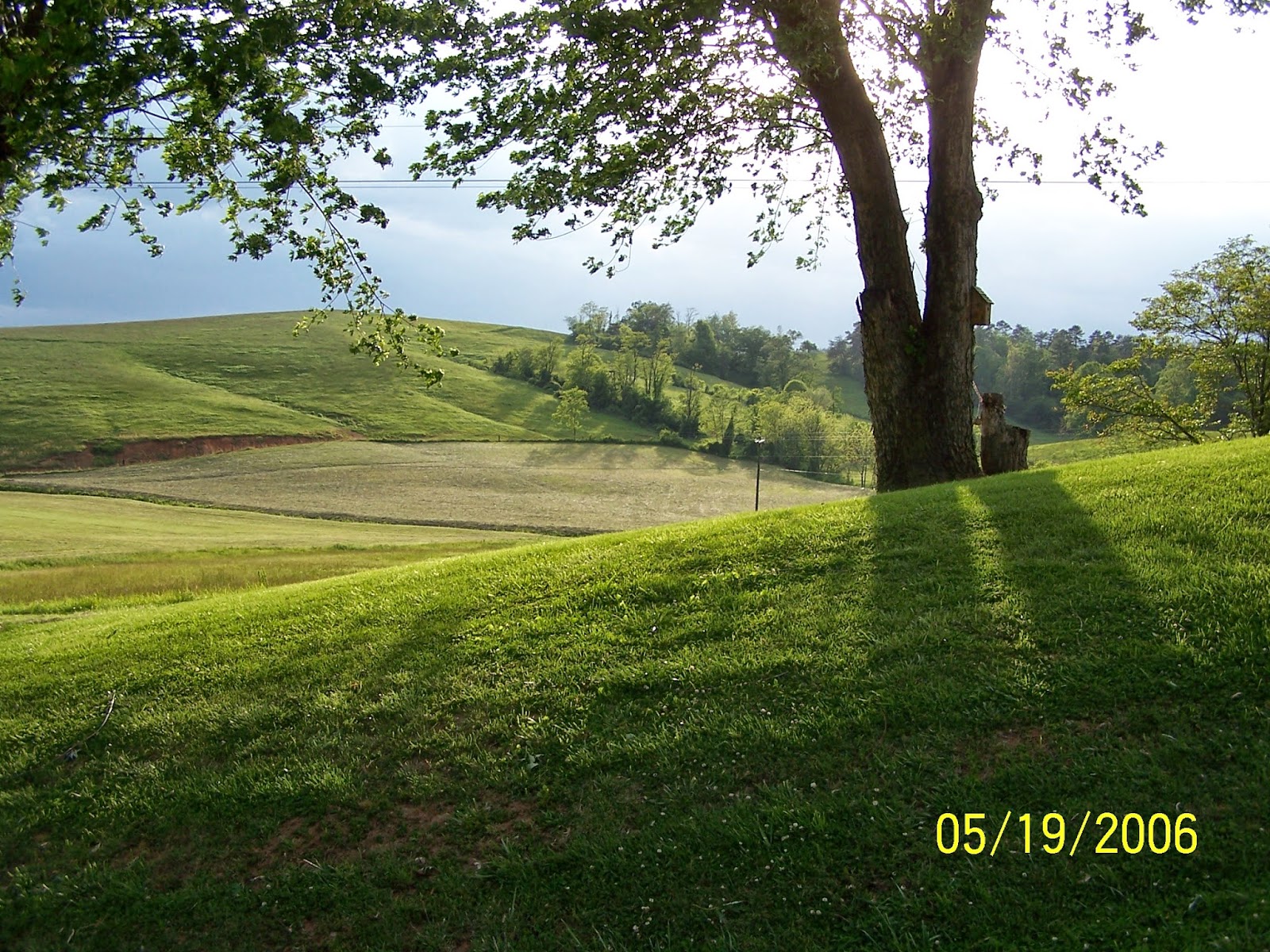
Buncombe Co NC (near Alexander)
John Patterson owned 170 acres
surrounding the land from which this picture was taken.
Thomas Patterson owned 50 acres beyond the distant hill.
(photo taken by Wes Patterson, May 19, 2006)
Oldest son Thomas Patterson (my ancestor) moved to Buncombe Co NC in the 1790's apparently, perhaps even a little earlier. He was still living there in 1800 near his son John (also my ancestor). However, Thomas' land in Buncombe was sold at auction by the sheriff a couple years later, and nothing further has been found regarding Thomas.

So it appears that the legend of multiple brothers applies to Thomas, James, Robert, Peter, and William Patterson. We're not sure what happened to William, but it seems James and Peter died in SC. Thomas died in NC apparently, and Robert II settled in Tennessee, thus fitting the legend that the brothers "split up". 

Our family from north Georgia always knew of our ancestor John Patterson, the old patriarch who died not too many years after migrating to north GA from western NC in the 1820's. Old John died after 1840 but before 1850, but that's all we know. This is the same John that was living in Buncombe in 1800. We now know that John was the oldest son of Thomas Patterson (one of the five brothers of family legend). 

John Patterson was born ca. 1762-65 and died in Union Co GA after 1840. He was my gggg-grandfather. Therefore my ancestor (Thomas) who was one of the legendary brothers, was my ggggg-grandfather. Perhaps one day I'll find where he died and was buried. Why not? Those other "dreams" of finding their names, locations, and dates all came true!

WP

Friday, August 12, 2011

Productive Diversions

Sometimes I get so deep in research on a particular topic that the end result is I'm so deep I can't see much. It's like the old saying, "You can't see the forest for the trees." Apparently that applies to family trees as well.

I've learned over the years I have to force myself to switch gears and go work on a different tangent, some other avenue of research. It may be about the same person, but a different part of his life or at a different location.

This is precisely what I've done the last couple of days regarding my ancestor Robert Patterson (d. 1775 SC). Much time and effort has been spent of late on his years on Linville Creek in VA. A lot of progress has been made and I'm getting closer to pinpointing exactly where he lived. But it's time for a break.

So I've switched over to his time prior to that - in Sussex Co DE. In 1732 Robert Patterson bought 106 acres on Pemberton's Branch (of Broadkill River). Past research has allowed me to get fairly close to where this was, but like Linville Creek VA of late, the road blocks appeared. So the last couple of days I've picked that up again as a diversion, to clear my mind of VA and focus on something new.

SUCCESS!

I am in the process of documenting my findings and will publish them in my next post. But I can say with great confidence that I have identified the exact location of Patterson's 106 acre tract in DE. He sold it in 1738 when they were preparing to move to VA. Between his buying and selling deeds, plus future dispositions of the land, coupled with the advancements of modern mapping tools on Yahoo and Google, I have located the spot where it stood. And don't forget the best tool of all - DeedMapper. With the latter program I know the shape of the tract which is critical to finding it on modern maps.

So why couldn't I find it before? Who knows? But this is an example of a PRODUCTIVE DIVERSION. You'd be surprised at how often this works for me.

WP

Tuesday, August 9, 2011

Joseph Harrison of Sussex Co DE & Augusta Co VA

In July 2010 Harald Reksten was working the Sussex Co DE Court Records. He abstracted a set of records and emailed them to me with the following message:

While looking at the court records I came across these entries about Joseph Harrison that I copied from the microfilm. These records are not published so no one would know about them unless they looked at the microfilm. Notice the references to Joseph Harrison as early as 1725. Makes me think the Joseph Harrison that died in the 1740s Augusta was not a grandson of Isaiah. Also this Joseph could have had quite a few children since he is involved in court cases as early as 1725. Makes me think he is at least the oldest son of old Isaiah's 2nd marriage.

The Isaiah Harrison in question is the old Isaiah Sr who was first married to Elizabeth Wright and then secondly to Abigail Smith. Joseph Harrison died in 1748 Augusta Co VA. Other members of the Isaiah clan were part of the estate settlement in 1748, but Joseph has never been conclusively placed within the Isaiah family. Harald and I believe Joseph was another son, by the second wife.

The Harrisons and Pattersons migrated from Sussex Co DE to Augusta Co VA in the late 1730's. Other families who migrated from DE to VA that were associated with them were the Blacks, Cravens, Stewarts, Ponders, Hoods and others. My Robert Patterson had a sister named Elizabeth who married Jeremiah Harrison (son of Isaiah) in DE. Additionally, Robert Patterson's son, Thomas Patterson (my 5-greats-grandpa) married a Margaret Harrison.

I used to think she was a daughter of Joseph, and then I thought she was a daughter of Samuel. Samuel and Joseph Harrison were brothers. Both of these theories have proven to not hold water,  however. As of 2018, I believe she was a grand-daughter of Gideon Harrison (son of Isaiah), who died in Sussex Co., DE in 1729.

FEBRUARY 1724(5) (Microfilm)
108. 2 February 1724(5) Preservd Coggshall vs Samuel Black. Continued Withdrawn.
109. 2 February 1724(5) Christ. Tophan agt Joseph Harrison. T.C. Sherd amoried – unto the Deft – appear the first day of next Term.

MAY 1725 (Microfilm)
115. 4 May 1725 Christopher Topham agt Joseph Harrison. The said Tophaim appeared for himself T.C. Sheriff amoried ¾ unless ye Deft. appear the first day this Term with Drawer in Costs.
116. 4 May 1725 Wm. PettyJohn vs Isaiah Harrison. David French for ye plantiff appeared T.C. Isaiah Harrison appeared by his attorney Francis Allen. Continued.

Thursday, August 4, 2011

Abigail - Daughter of Robert & Sarah Patterson

Not too many researchers know about Abigail Patterson, a child who was baptized in 1740 in Augusta Co VA on the frontier. And those who have seen that record, assume she was the daughter of the wrong Robert Patterson.

However, in March of 2009 it was discovered this young girl was actually the daughter of Robert and Sarah Patterson, of Linville Creek. In fact, this is the only known record of an Abigail Patterson as the daughter of Robert. I would suggest we'd never have caught onto her were it not for the fact that someone else was baptized the same day. Someone we do recognize. Her Uncle Jeremiah Harrison.

Rev. John Craig was the first resident Presbyterian minister in Augusta Co VA. He was there from 1740-1749, and baptized a lot of people both children and adults. He kept meticulous records of these baptisms, for which we are truly grateful.

3 Nov 1740 Abigail Patterson & Jeremiah Herison (sic)

You may click on the image to see a larger version of it. Notice on November 3, 1740 there were two individuals baptized. Robert Patterson brought his child Abigail, and then Jeremiah Herison (Harrison) was also baptized. It also denotes the fact that Harrison was "an adult person."

The first item of importance is that Jeremiah Harrison was married to Elizabeth Patterson, sister of Robert. More importantly, though, is the unusual notation as to the location of the baptisms. It says "near Halfway House."

The Halfway House

Author J. Houston Harrison wrote on pages 128-129 in his book Settlers by the Long Grey Trail the following details regarding Jeremiah Harrison and this "Halfway House":

"Jeremiah Harrison, besides his brothers, owned various tracts of land on Cook's and Linville's Creeks. From his first patent for 370 acres on the drafts of Cook's and Linville's Creek it appears that he settled in the section now traversed by the Raleigh Springs Turnpike; probably near the present juncture of this pike with the road leading to Mt. Clinton. Just to the east of this juncture the pike crosses the northernmost branch of Cook's Creek while a little to the west the Mt. Clinton road crosses the southernmost branch of Linville's Creek. In the old church book of the Rev. John Craig, the first resident Presbyterian minister in Augusta, Jeremiah is spoken of as living at the 'Half Way House'. His name occurs on a petition for a road filed at Augusta court in 1753-54, by the 'Inhabitants of North Mountain, at the head of Muddy Creek'. The above juncture of roads is approximately midway between Harrisonburg and Mt. Clinton, and Jeremiah was probably about half way between Thomas Harrison's and the Muddy Creek community."

Thomas Harrison was Jeremiah's brother. Thomas' land became the town of Harrisonburg, which was named for him. So half way between Thomas Harrison's (the town of Harrisonburg) and the Muddy Creek community (a few miles west). See the following map which shows the town of Harrisonburg, as well as Rawley Pike (Raleigh Springs Turnpike) and Mt Clinton Pike, etc.


Robert Patterson, father of little Abigail, also lived "on the waters of Cook's and Linville's Creeks". Therefore he lived fairly close to his brother-in-law Jeremiah.

The fact that only a handful of baptisms during the 1740's were actually performed "near Halfway House", and two of them were the same day, I'd say there's no doubt this Robert Patterson was of the Linville Creek variety.

While we don't know exactly how old Abigail was, we do know that some infants as young as a few weeks old were baptized by Rev. Craig. Others I'm sure were a few years old, and as we've already seen, he baptized many adults as well. Did she die young? Could be. Did she get married in VA prior to the clan's move to the Carolinas? It's possible. What we do know is that her father Robert did not mention her in his will in 1775 in York Co SC. He did say something about "all my children is single" at one point, but that hardly sheds any light on the matter. However, it could be the one inclusive statement regarding Abigail if she was still living.

There was an Abigail Patterson in York Co SC as late as 1797. It's the only time we see the name there in SC. See the following deed:

E-502. 13 July 1797 Peter Patterson of York County to Malcolm Henry of same for £150 sterling, 150 acres on the waters of Clarks fork of Bullocks Creek being Pattersons branch of Clarks fork and also 80 acres adjoining it near Peter Patterson's lower field, the ridge road above Jacob Peters School House, Robert Love's corner at cross road and -------Ponder; also 62 acres on both sides of Clarks fork adjoining and originally granted to Robert Patterson Senior, deceased. Signed: Peter Patterson (Seal).  Witnesses: Robert Love, William Henry, Abigail Patterson.  Proved: 8 April 1801 by the oath of William Henry before Saml Watson J.P.

Who was this Abigail Patterson? She was not Peter's wife as it says nothing about being examined privately regarding releasing her dower. Was she Peter's daughter? Was she Peter's sister? Keep in mind that Peter was a son of Robert Patterson and therefore a younger brother of the Abigail who was baptized in 1740. Their father Robert had died in 1775. Their mother Sarah died in 1790. It seems that another sister, Sarah Patterson Black, lived on some of the family land during the 1790's also. It could be this was the same Abigail from 1740, and she never married. We may never know for sure, but I have to consider the possibility.

Just how many children DID Robert Patterson have?

WP

Monday, August 1, 2011

There Were Five Brothers

"My great-great-grandfather came to Georgia in the 1700's. June's got that he must have been the first Patterson to come to Ga. He came from N.C. That's where my Dad said 5 brothers came from the old country landed in N.C. They went to different places. Dad said they were Scotch Irish."
~ Aunt Nellie Patterson Mason, September 1982

I was fourteen years old when I received this second letter from Aunt Nellie. My grandpa Patterson had died in 1975 when I was seven years old, so I had missed out on any opportunities to discuss my Patterson heritage with him. My parents were missionaries in the SE Asian country of Bangladesh (beginning in 1979), so living 12,000 miles away from any other family members only added to my thirst for knowledge concerning my Patterson heritage.

At my dad's urging, I had written Aunt Nellie, the younger sister of my Grandpa. I had met her in person a few times and have fond memories of her to this day. Where Aunt Nellie said "Dad", she was speaking of Elijah Patterson (b 1871). Where she said "great-great-grandfather", she was speaking of John Patterson (b 1765 and married Margaret Black). It seems impossible that it's been 29 years since I received the above letter. And yet, I now feel as though I've come full circle.

The last 15 years have changed everything. Many brick walls in our on-going family tree search have come tumbling down. We know that old John Patterson that my Aunt Nellie referred to, was born in 1765 in what is now York Co SC. But at the time of his birth, it was considered Mecklenburg Co NC.

We know that John's father was Thomas Patterson, oldest son of Robert and Sarah Patterson. We know that Robert was born in the early 1700's. Some say 1705-10, I like to say circa 1711, but both are possible dates for reasons I won't entertain here. Robert was living in Sussex Co DE in the 1730's where some of his oldest children were born, perhaps. Most of his children were born in the Shenandoah Valley of VA, where all of them were raised.

In the early 1760's it seems that most of this Patterson clan and other relation migrated to the Kings Mountain region of the Carolinas - modern day York Co SC. But again, it was North Carolina at the time, so Aunt Nellie's version of the story is accurate.

They were Scotch-Irish (aka Scots-Irish, aka Ulster Scots), so again, Aunt Nellie's recollection was spot on.

For years now we only knew of four sons of Robert and Sarah Patterson. Recent developments have proven there was at least a fifth, James Patterson, who died in 1774 or 1775 just before Robert Patterson penned his Last Will & Testament in July 1775, leaving James out of the Will for obvious reasons.

So, there were five brothers. Aunt Nellie was right.

My chief goals in life (in regards to genealogy research, that is) when I first began this quest some 30 years ago were to find out 1) how many brothers there were, 2) what their names were, 3) which one I descend from, 4) when they "arrived", and 5) where they went.

Many stories I heard about these brothers listed different states they moved to, but there was always one that was a mystery. They weren't sure what happened to the fifth brother. While Aunt Nellie didn't say anything to that affect, I heard this from more than one relative.

This blog post is a special one for me. It's post #100 for this blog. Nothing earth-shattering, mind you. But still a special one. That's why I'm writing about this 29 year old letter. That's why I'm remembering Aunt Nellie, and the stories I heard as a youngster about my Patterson heritage. I'm returning to my roots - MY roots. My early years growing up in the 1970's and '80's.

Answers

1) There were five brothers.

2) Their names were Thomas, James, Robert Jr, Peter and William.

3) I descend from Thomas, the father of old John Patterson who moved to GA.

4) Thomas may have been born in DE or VA, I'm not yet sure which. The rest were born in VA near Harrisonburg on Linville Creek. That is where they and their sisters were raised. There were no less than five sisters, as well.

5) Thomas eventually ended up in North Carolina. James died a young man in South Carolina. Robert Jr died in Tennessee. Peter died in South Carolina also. And William? Well, we still don't know what happened to him. Last known record shows he was a Loyalist during the Revolutionary War, in South Carolina. He may have died during that war. He may have moved away as so many Loyalists did. We just don't know.

So, while the five brothers didn't immigrate from the "old country" per se, they did migrate to the Carolinas (from VA) in the 1760's.

And, while John Patterson didn't actually move to GA in the 1700's, he did move to NC in the 1790's and then moved down into GA "from N.C." in the 1820's.

Aunt Nellie passed away in 1996. It's taken almost 30 years for final confirmation on many pieces of her story, but I'm just grateful to have had her story, in her own writing. Thank you, Aunt Nellie. And, thank you June Walker Brown, another Patterson cousin whom Aunt Nellie was quoting at one point. Sometimes family legends can be right after all!

WP

Friday, July 29, 2011

And I Thought There Wasn't Much To Find On Him!

When I first began researching Robert Patterson of York Co SC (more than a decade ago), I just didn't think there was much on him to be found. I knew he had a Last Will & Testament, which is more than a lot of people had in those days. I knew he owned land, but that's only going to show up in a handful of recorded ledgers.

Let's face it, the man lived in the 18th century. How much could be found on someone who lived on the New World frontier, most of it in antebellum South where records were destroyed a century later, and it being a man who could not write as far as we know. After all, he made a mark - an "R" - instead of signing his name. 

Several years ago I got one of those proverbial burrs in my saddle and decided to build a "Timeline of Recorded Events" for ole Robert. Naturally, the first item on the list was his Last Will & Testament from July of 1775, the same year he died, incidentally.

I added anything I could find to this list, from North and South Carolina, Virginia, and Delaware. It just had to be an event that was recorded and dated somewhere along the way - you know, a "primary source". When my list reached 20 events I was amazed and even shocked. I was impressed that Robert Patterson was "visible enough" to have been recorded in some manner that many times AND the records had survived two and half centuries.

Little did I know.

Harald Reksten has continued to review the numerous records along Robert Patterson's migration route and has shared much of this data with me over the years. The problem has been sorting out the various Robert Pattersons along the way. It has taken time for me to research the neighboring families in the various locations Patterson lived, but it has been necessary in order to gain a better understanding of which Robert Patterson was which.

To my utter shock - and pleasure - many more of these "Robert Patterson" sightings have been this Robert than previously thought. These recorded events are too numerous to post in this article. Nor is that the purpose of this article. 

The scope of this article is "one-fold". Is that a word? It is now. 

Don't give up on looking for your ancestor!

There. That's it. That's my point. 

I now carry a notebook with me almost everywhere I go. When I find another confirmed, recorded event for Robert Patterson, I add it to my notebook. I use this notebook for this purpose only, and for many ancestors, not just my 6-greats-grandpa. 

Would it shock you to realize that I have no less than 56 confirmed, recorded events for Robert Patterson from 1732 to 1825? Yes, a dozen or so of these recordings were done so posthumously, but they count. As far as I can tell, he lived in three locations only from 1732 to 1775. In Sussex Co DE he lived off the Broadkill River. In VA he lived on the waters of Linville Creek and Cooks Creek. In NC/SC he lived in one location off Clarks Fork of Bullocks Creek.

Here's a quick summary, by decade, of the number of recordings throughout his life, so far:
  • 1730's = 3
  • 1740's = 9 8
  • 1750's = 17 19
  • 1760's = 8 9
  • 1770's = 7
  • 1780's = 4
  • 1790's = 2
  • 1800 and later = 5 4
A total of 55 56 times. This one thing I know - we'll find more [WP: since this article was posted, two duplications have been removed, but three more recordings have been found and added - 2 Aug 2011]. The earliest found was in 1732 in Sussex Co DE. The latest found was in 1825 in Rockingham Co VA. 

And I thought there wasn't much to find on him!

WP

Thursday, July 28, 2011

A Lesson in Genealogy

So often we take for granted the need to carefully document an event we've researched in our never-ending quest for genealogical omniscience. For example, my 6-greats-grandpa (Robert Patterson) obtained a Virginia Land Patent (grant) in 1764 for 265 acres on Linville Creek near Harrisonburg.

Big deal. Get a copy of the 1764 patent and you're good to go.

Well, not so fast.

You see, there were at least three recorded events pertaining to this tract. In 1740 there was the Land Entry. Patterson recorded the tract as 230 acres in the Orange County VA Land Entry book.

And then there's the survey which was done and recorded in the Augusta Co VA book of surveys. The survey was for 265 acres instead of 230.

Then there was the Land Patent, issued and recorded in 1764, also for 265 acres.

Here's the lesson. If I were doing my research and all I had found was the 1740 Orange Co Land Entry, I would think Patterson owned 230 acres on Linville Creek.

If all I had found was the Augusta Co Survey, I would think Patterson owned 265 acres on Linville Creek. But I would have also been led astray by the survey on a couple other matters. Here's the 1753 survey (15 Dec 1753, Augusta Co VA, 1-070b):

(Image courtesy Harald Reksten)

The survey is not oriented to North, by the way. You need to rotate the tract 60 degrees clockwise (North 60 degrees East) to get an accurate rendering.

The bottom right corner says "Red Oak near Hits Line". Joist Hite was a prominent land holder in the Shenandoah Valley. He received thousands of acres patented to him and some business partners. Many surveys would indicate a "joining to" Hite's line or Hite's corner, etc. Often, it was spelled "Hit" or "Hits". Problem is, all indications have always said this Patterson tract was near Abraham Hill's tract, such as "near Hill" or "near Hils Line". So this is misleading to some degree. Is it Hill or Hite?

Another problem with the survey is that on two of the seven lines, there is an error in the direction recorded in the survey book. Without the 1764 patent, you wouldn't get the correction needed. Two of the directional descriptions in this survey says "W" instead of "E", or vice-versa. All of the "N" and "S" beginning directions are correct, it's the degrees direction that is off two times. In other words, "N60E244" would indicate North 60 degrees East 244 Poles. This means that from this point, face due north, then turn 60 degrees to the east or clockwise, then go 244 poles to the next point. Each "Pole" is 16.5 feet by the way.

Here's the 1764 survey Land Patent (27 June 1764, Augusta Co VA, 35-516):

(Image courtesy Doris Ross Johnston)

There are two pages here. On the first page, on the fifth line from the bottom of that page, in the middle of that line, you can clearly see "Hills Line". All seven directional descriptions for the lines are accurate here as well.

Our lesson in genealogy with this example is that no one record by itself is sufficient to give us a full picture about Robert Patterson's involvment with this land and the scope of this land. The patent gives us the most accurate description of the land - its scope - but by itself, you'd think Patterson just acquired it in 1764. If you found the survey, you might then realize that he had it surveyed in 1753, so perhaps he was already living there by that time.

In reality, he entered the land in the record books in 1740. In fact, he entered it twice, the first time in 1739, and then entered again in 1740. We also know that he sold his DE land in 1738, and that many of his relatives and neighbors from DE had moved to the Linville Creek area in 1737 and 1738.

The point? You need to pull all associated records to get the big picture. You need all associated records to clear up any scribal errors by the county officials, of which there were many.

It's a tough lesson to learn sometimes, but it's a lesson that comes with benefits. Keep that in mind.

WP

Wednesday, July 27, 2011

Robert Patterson's Linville Creek Land

Last night I was all set to post an article I'm calling "Part 2" regarding the specific location of Robert Patterson's 740 acres on Linville Creek near Harrisonburg, VA.

But as fate would have it, a couple of new issues popped up.

First issue - I found another map that gives a little more detail on the branches and forks of Linville Creek, so that is forcing me to make some changes to my custom maps. It's a wonderful development as it's more precise, but it's a little different so I need to make some changes before I can post it.

Second issue - there may be one or even two more tracts that our Robert Patterson had there in VA, not just the three I've been talking about. Problem is, I'm not convinced either of those are his. One or both "could be", but it will take some time to determine that. One was for 100 acres, and the other for 150 acres.

So for now, I will continue forward with what I have, which is three confirmed tracts for 740 acres. I'll make the changes to my "Part 2" article I'm almost finished with, approximating where this land was (within a mile or so, which is pretty dawg-gone close, if you ask me).

And, we'll (Harald and I) continue to work on the other two tracts to determine if they belonged to our Robert "R" Patterson or the other one.

WP

Saturday, July 23, 2011

Linville Creek VA Early Settlers and Patents

The following resource notes are a collection of notes I've been studying of late. This post is simply a place to house them - together.

1) Linville Creek Timeline

This site gives a rich historical timeline regarding major events along Linville Creek, particularly some of the earliest patents and settlers. The 1739 event is of key interest to me, as my ancestors' patents butted up against this 7009 acre patent, and eventually including deeds containing pieces of this large tract.

7009 acres were granted to Hite, McKay, Duff, and Green at Linville Creek in Rockingham. This was surrounded by Fairfax lands that many tried to stay away from. The core grants, about 11 square miles of the 24 square miles for Rockingham County included lands on Linville Creek and it's main tributaries. This became the neighborhood of the Eymans, Brennemans, Shanks, Lincolns, Boones, Bryans, and related families.

2) Land Records of Robert Mackay Sr

Mackay was one of the patentees of the 7009 acre patent along Linville Creek in 1739. This site contains a great overview of the various patents Mackay and his associates were involved with in those early years in the Shenandoah Valley.

3) Great historical migrations, personal histories of key settlers, and even migration route details. As labeled on this site: English | Scots-Irish | The Great Wagon Road | German

The histories presented on this site reflect the migrations through the Shenandoah Valley and on into the Piedmont of NC (Yadkin River Valley) and in some cases on down to York Co SC around Kings Mountain.

4) William Linville Timeline

William Linville was the namesake for Linville Creek. He was the original owner of what is now Tanglewood Park in Clemmons, NC. He was the namesake for all things "Linville" in western NC, where he and his son John were killed in 1766 by Indians near what is now known as Linville Falls.

5) Thomas Linville Timeline

Brother of William Linville, Thomas owned land on Linville Creek, VA as well, and then later in NC between modern day Winston-Salem and Kernersville. Linville Road is named after him.

6) Joseph Bryan Timeline

Joseph Bryan was married to the sister of William and Thomas Linville. His daughter Rebecca married the famous Daniel Boone.

Again, these notes are simply a collection of related research that shares pertinent details regarding the history of our nation and settlements where my ancestors were. In fact, my ancestors knew these folks personally.

WP


Popular Posts (Most Viewed)